Bird of Paradise: Bee-Friendly & Xeric

8 Jun

Its gifts are double, this strange flowering bush-tree. It’s called Yellow Bird of Paradise ( Caesalpinia gilliesii) and it grows shockingly well in Albuquerque without much supplemental water which is a boon for city-kept bees.

Currently, my girls are harvesting both nectar and pollen from Caesalpinia gilliesii like sincere clowns in a circus display. Some dangle and bob from long red stamens plucking what pollen they may. Others, more aggressive perhaps, dive straight in and deep where nectar lies at the bottom of petals the color of egg yolk.

Harvesting nectar from the yellow bird of paradise bush

Harvesting nectar from the yellow bird of paradise bush

Langstroth + Top Bar = A Very Confused Bee Hive

1 Jun

This here’s a little tale about how we supered our top bar hive. Yep, I hear the purists cringing and the aesthetes too. And they’re right — we’ve got a Frankenstein on our hands.

All super-ed up and ready to grow

All super-ed up and ready to grow

Why did we do it?

The Kerry hive is full beyond belief — every bar is packed with honey, pollen, and fresh worker brood. No matter how many bars I harvest, the girls are drawing more within a short week or two and showing no signs of a slow down. It’s a full house.

So, rather than fight the gift of a madly productive hive, we’re rolling with it.

How did we do it?

First, let me admit it’s all my partner’s idea.

He’s obsessed with Langstroth hives and secretly bought a couple to “experiment with.” Next thing I know, I hear myself saying it’s OK to add Langstroth honey supers to a top bar hive which, were I sober or not in love with him, I’d have thought the most perverse of sins.

So here’s what we did:

  1. Remove one bar from the back of the hive
  2. Cut spacers about 3/8 inch (enough to allow “bee space”)
  3. Put spacers between bars at the back of the hive
  4. Place an empty super on top of the spaced bars at the back of the hive
  5. To provide evenness for a cover, place an empty super at the front of the hive (there’s no space yet between the bars underneath this super)
  6. Place a cover on top of both supers

And here’s the photo essay version…

Continue reading

Interview with a commercial top bar beekeeper

28 May
Les Crowder, photo by RD Managain

Les Crowder, photo by Jeff Spicer

Bioneers’ RD Managain just interviewed Les Crowder, a veteran commercial beekeeper in New Mexico.

Crowder on varroa resistance:

 I started keeping bees when I was a kid. It was then I read an article in the American Bee Journal was reading about the varroa mite in Europe, written by an Italian who was researching the Italian honeybee in its natural state. He calculated how many feral beehives there were throughout Italy. When the varroa mite arrived, many of the feral hives died.

About eight years after the arrival of the varroa mite, he noticed a general increase in the feral Italian honeybee population in the wild. He concluded that they had developed a natural resistance to the mite. And, of course, nobody applied any miticide to those bees. They’re just wild bees out in nature. So, honeybees left alone will naturally develop mite resistance.

On antibiotics:

Antibiotics interfere with their digestion, just like if we take antibiotics we get diarrhea sometimes because we kill off our natural flora. My wife just recently wrote an article for the American Bee Journal, which they declined to print, indicating that the use of antibiotics can set up conditions for things like Candida and Nocema cerranae [a pathogen tentatively linked to colony collapse disorder] in honey bees. In beekeeping, they advise you to give antibiotics to bees, every beehive, every year as a preventative. It is administered in the winter to prevent them from getting sick in the summer, which doesn’t make any sense.

[Read the full interview with Les Crowder]

Double Team: Two queens in one hive

23 May

Flouting all objection to polygamist cults, I’ve got two queens in the Kerry hive.

While to some this might make for “sweet sweet lesbian bee action“, in my case it’s just honey overload and a fat, fat hive.

  • In the front, I think the old queen is laying.
  • In the back, I’ve got a new queen laying. And how prolific! In an utterly beautiful tight pattern, she’s laying combs of dark bees (Russian? Carnolian? Hopefully not “Africanized”).

Why the harmonious co-existence?  Aren’t Apis mellifera queens renowned for their Battles Royale, fighting brutally until only one remains victorious? 

Alex, examining the Kerry Hive

Alex, examining the Kerry Hive

Perhaps my hive is undergoing a drawn-out supercedure. Or perhaps they’re waiting to swarm. All I can say for certain is that:

  1. Queens are piping when I open the hive
  2. There are two brood nests
  3. There are new dark bees in the hive
  4. The girls are producing ungodly amounts of honey

If the unusually cloudy weather in Albuquerque ever clears up, I’ll open the Kerry hive again and sleuth out more details.

The cactus bees are here!

19 May

At least in Albuquerque, the docile European honeybee hasn’t totally edged out our natives.  The prickly pear cactus in my yard has just started blooming which attracts bees from the genus Diadasia, also known as cactus bees.

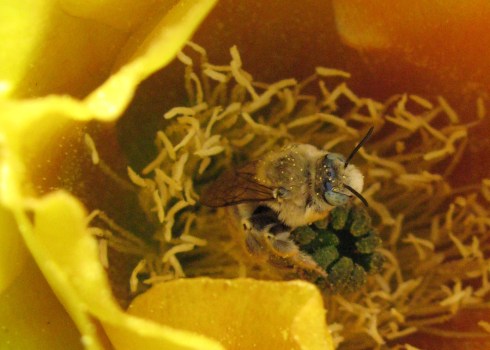
One very blissed-out cactus bee

One very blissed-out cactus bee

These kids are spazzy — like my niece Nina after those twinkies Mimi insists on feeding her — they duck and dive and roll. With the kind of lust possible only after desert-induced deprivation, cactus bees fling themselves into a flower and cover their entire bodies with pollen. 

Utter abandoned bliss.

If chocolate suddenly disappeared from shelves in North America, you’d find me with the frenzy of a cactus bee, bathing in Scharffen Berger the minute I tracked down a source.

omg. honey.

18 May

Despite quite convincing threats, the Kerry hive never swarmed. And you know what that means — HONEY.

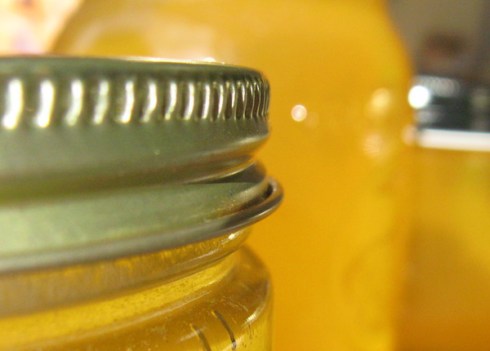
Mighty tasty light Spring honey from my "Fringecrest" neighborhood in Albuquerque

Mighty tasty light Spring honey from my "Fringecrest" neighborhood in Albuquerque

Over the past couple days, I’ve harvested 25 pounds of fragrant Spring honey from the Kerry hive whose occupants gave up swarming in favor of foraging. Every bar but two in that hive was filled with either honey, brood, or pollen which means my kitchen has been sacrificed to the honey gods for a full-time straining operation.

I’m out of strainers, I’m out of jars. And yet the honey still flows.

Vintage 2009

Vintage 2009

Vacation Pollination: Saguaro

16 May

Seeing the saguaro bloom was the only thing I wanted for my birthday. And I got it.

Daylight pollination of the saguaro cactus

Daylight pollination of the saguaro cactus

A four day weekend in Tucson, AZ and a 6am hike in the Sonoran desert chalked up the moment I was waiting for… Though the stately saguaro cacti are usually pollinated at night by bats (the Lesser Long-nosed Bat, to be exact),  the blossoms remain open for a few hours each morning giving local honeybees a shot at the goodies.

[More saguaro photos on Flickr]

New photo of the White House bee hive

4 May

Forget pork, it’s honey season at the White House and how sweet it is.

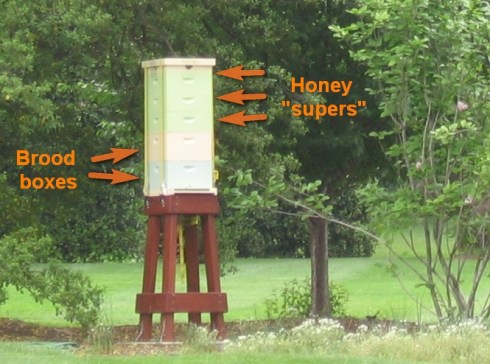
Bee hive on the White House lawn

Bee hive on the White House lawn

My fiancé’s family visited D.C. this Saturday and snapped a few photos of the hive which, as you can see, is towering with 3 honey supers up top. 

Some notes on the White House beehive

Some notes on the White House beehive

Thanks

Mike, Sabrina, and Paul on their daytrip from Chicago to D.C.

More on the White House honeybees:

Free diagram and plans for a top bar hive

3 May
Updated: Oct 2012

Looking to build your own top bar hive?

If you’re a new beek, consider reviewing this pragmatic comparison of TBH vs. Langstroth hives. And if you’re ready to build, here are some designs:

Standardized Top Bar Hive (TBH):

Standard Top Bar Hive design

The standardized Top Bar Hive design by TJ Carr

I recommend using a standardized TBH design for innumerable reasons, including the ability to share resources between your hives and with others in your community. Here are my favorite plans by longtime Albuquerque beekeeper and retired engineer, TJ Carr, and John Bradford.

Other TBH Plans:

Or, do you prefer to buy one?

Bees a-swarming at the Albuquerque Botanic Gardens

29 Apr

Aww… ain’t it sweet?

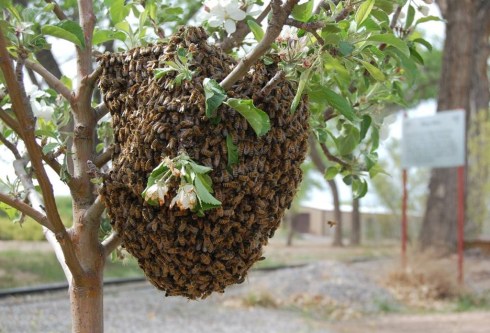
The good times are rolling at the City of Albuquerque BioPark where resident honey bees are swarming as we speak.

I wrote about the BioPark bees last year, introducing their keeper Tomás.  Even more lusciously, I’ve tasted the BioPark honey which bursts with floral notes and the promise of fruit, seriously rivaling the bouquet of the Serenade Blend made by Casa Rondeña winery further up the valley. Touché!

Surrounded by 36 acres of carefully-tended gardens at the BioPark, it’s no wonder their girls are burgeoning.

Photo by Erik Andersen, courtesy of ABQ BioPark. This photo was taken on Monday, April 27, 2009.  The swarm has now moved on.

Photo by Erik Andersen, courtesy of ABQ BioPark. This photo was taken on Monday, April 27, 2009. The swarm has now moved on.