Archive | Spring RSS feed for this section

Grow Yer Own: Bee Friendly Plants from Seed

29 Jan

Tis the season — restless and cold-weary — to dream up the summer’s homegrown delights. This year, consider adding a few nectar-rich items to your smorgasbord for neighborhood bees.

Bee Balm (Monarda citriodora)
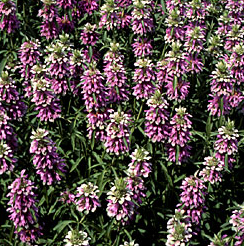
Bee Balm

Used by Native Americans to brew a tea; replaced black tea during the Boston Tea Party. Citrus-flavored leaves can be minced and added to fruit and used for jellies. Beautiful purplish bracts, 24-30″ tall, aromatic and colorful in fall. Excellent bee forage plant. Hardy perennial in zones 5-9.

Available at SeedSavers

Bee’s Friend (Phacelia tanacetifolia)

Bee's Friend

Can be used to strongly attract bees to your garden. “Bienen-freund” in German translates as “bee’s friend.” Subtle lavender-blue flowers with curved spikes that are absolutely covered by many different species of bees. Excellent results when used as an annual cover crop. Approximately 16,000 seeds per ounce. Annual, 12–24″ tall.

Available at SeedSavers

Borage (Borago officinalis)

Borage

Bushy, fuzzy-leafed plants produce edible 1 in. blue flowers that bees love. Tasty in tea and salads, the flowers also make pretty cake decorations.

Available at SeedsofChange

Cleome, Spider Plant (Cleome hasslerana)

Cleome

Bees and hummingbirds love this flower! Multi- branched plant produces whorls of pale pink to purple flowers at the top of the stems. Flowers have long protruding stamens, giving a spidery appearance.

Available at SeedsofChange

What else?

What have you found attracts bees in the ‘hood?

Vacation Pollination: Saguaro

16 May

Seeing the saguaro bloom was the only thing I wanted for my birthday. And I got it.

Daylight pollination of the saguaro cactus

Daylight pollination of the saguaro cactus

A four day weekend in Tucson, AZ and a 6am hike in the Sonoran desert chalked up the moment I was waiting for… Though the stately saguaro cacti are usually pollinated at night by bats (the Lesser Long-nosed Bat, to be exact),  the blossoms remain open for a few hours each morning giving local honeybees a shot at the goodies.

[More saguaro photos on Flickr]

Bees a-swarming at the Albuquerque Botanic Gardens

29 Apr

Aww… ain’t it sweet?

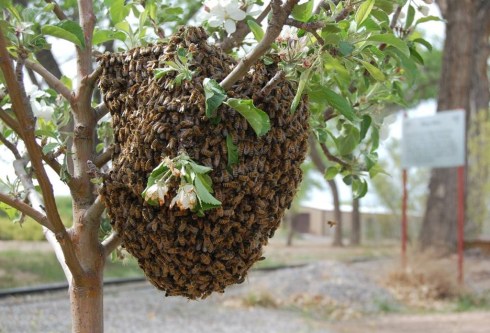
The good times are rolling at the City of Albuquerque BioPark where resident honey bees are swarming as we speak.

I wrote about the BioPark bees last year, introducing their keeper Tomás.  Even more lusciously, I’ve tasted the BioPark honey which bursts with floral notes and the promise of fruit, seriously rivaling the bouquet of the Serenade Blend made by Casa Rondeña winery further up the valley. Touché!

Surrounded by 36 acres of carefully-tended gardens at the BioPark, it’s no wonder their girls are burgeoning.

Photo by Erik Andersen, courtesy of ABQ BioPark. This photo was taken on Monday, April 27, 2009.  The swarm has now moved on.

Photo by Erik Andersen, courtesy of ABQ BioPark. This photo was taken on Monday, April 27, 2009. The swarm has now moved on.

Reflections on a Swarm

26 Apr

I dreamt of bees last night, like curious stars filling my sky.

They danced, those randy fire twirlers, and blocked my light with their own exuberance. Ten thousand bees hurled themselves like unshackled inmates from the hive into the sky above, blue and capacious.

Oblivious to me, they tumbled and bounced and chattered, colliding after some minutes into a mass of vibrating heat.

Now, they hang heavy from a single, dry twig. While I stand motionless as in a pool of warm mud.

Bee swarming FAIL

25 Apr
 
After being unable to convince their queen to swarm, the bees release a pheromone telling everyone to return home

After being unable to convince their queen to swarm, the bees release a pheromone telling everyone to return home

The Kerry Hive has been owned.

After nearly a month of threatening to do so, our strongest hive swarmed today. With great huzzah, thousands of divas escaped the hive and took to the sky like buzzing parade day confetti.  They formed a cluster on a nearby tree and called thousands of their sisters to join the party.

And then they changed their mind.

Whether the queen refused to join them, or couldn’t because her wings were clipped, we’ll never know.

All we can say for certain is that everyone returned home for the night and that we’ll likely be on swarm patrol again tomorrow.

Photo of Swarm vs. Supercedure Cells

20 Apr

How can you tell the difference between a swarm cell and a supercedure cell? 

As a new beekeeper with energetic girls, I’ve had plenty of opportunities to learn the difference. Now predicting what happens when a hive starts building these cells is anyone’s guess…. but here’s what look like and where you can find ’em on the comb.

In a Top Bar Hive:

  • Swarm cells are typically built on the edge, side, or bottom of a comb.
  • Supercedure cells are typically built smack in the middle of the comb.
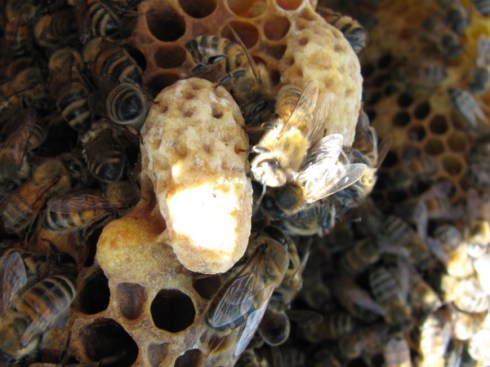
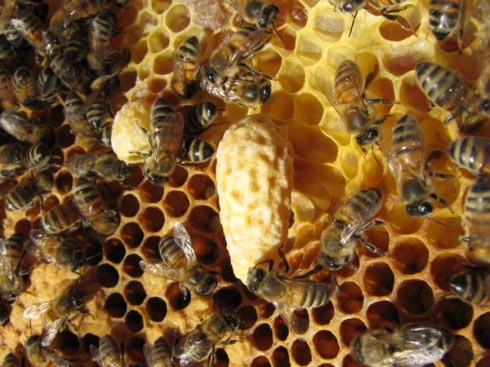
2 capped swarm cells, built on the edge of the comb

2 capped swarm cells, built on the edge of the comb

Queen cup (left) and capped supercedure cell (right), both built in the middle of the comb.

Queen cup (left) and capped supercedure cell (right), both built in the middle of the comb.

In a Langstroth Hive:

Things are slightly different in a Langstroth hive, but here’s a useful discussion indicating that in a Langstroth:

High Drama and the Virgin Queen Piping

18 Apr

My little bee brain is buzzing with information overload.

Today’s hive inspections brought plenty of good news but also a wild cornucopia of new bee experiences. I think I need a drink.

Alex opening the Ann Hive

Alex opening the Ann Hive

But first, here’s what went down:

  • We found queens and eggs in the Ann Hive and the Polski hive. Yay!
  • At least 10 capped swarm cells awaited us in the Kerry Hive.
  • It was impossible not to hear the high-pitched squawk of a virgin queen in the Kerry Hive which we tracked down and photographed. 
  • We removed 7 bars of brood and resources from the Kerry Hive and gave some queen cells to a local beekeeper in need.
  • The extra swarm cells we dissected.
  • Opening some drone cells, we found varroa mites on drone pupae.
  • We saw a birthing bee.

Photos and details follow. Whew! Who knew one afternoon in the life of a beekeeper could be so fascinating.

Continue reading

The Great Rosemary Bloom

6 Apr

I moved to Albuquerque for the rosemary. Unlike Chicago, here you can grow rosemary outdoors, harvesting its resiny leaves 12 months a year for your polenta and scones and garlicky lamb.

And if Winter was wet enough but not TOO wet, rosemary shrubs in Albuquerque will bloom each Spring like a cloud of violets drawing bees from miles around.

Honeybee and rosemary

Honeybee and rosemary

The Pollen Files: Three-Leaf Sumac

28 Mar

Spring is a fickle vixen in the high desert of Albuquerque. Three weeks ago, the girls were feisty and fixin’ to swarm. Last night, the water in their bird bath was frozen.

Never you mind, though, because the pollen rush continues.

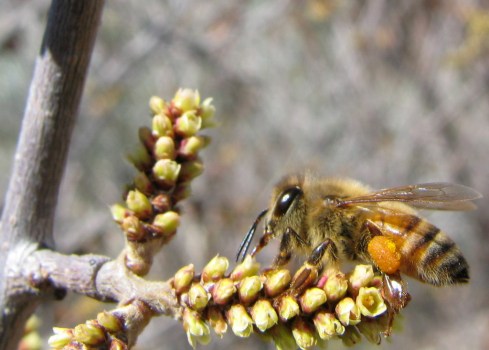
Gathering nectar and pollen from three-leaf sumac

Gathering nectar and pollen from three-leaf sumac

Walking past a nondescript bush this afternoon, I noticed it vibrating with activity like a bowling alley on league night. It’s three-leaf sumac (Rhus trilobata), a desert shrub whose glory days come each fall when the leaves turn bright, bright red.

But my honey bees love it now. As it blooms in early spring from tiny pale catkins, they swarm it like the high school wallflower turned ravishing beauty at their 10 year reunion. Rhus trilobata is in its prime.

The Pollen Files: Gopher Spurge

19 Mar

Otherwise oblivious to my surroundings, keeping bees has forced this big city girl to slow the hell down and smell the pollen.

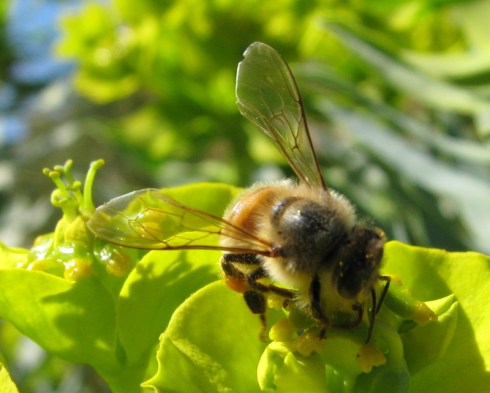
Hardly a captivating show, gopher spurge is one of the earliest bloomers in Albuquerque but my girls found it immediately. Not only does gopher spurge give up a juicy load of nectar but it produces pollen too, with a coral, almost red color.

Honeybee collecting pollen from gopher spurge

Honeybee collecting pollen and nectar from gopher spurge


The last bee bears the coral-red pollen from gopher spurge

The last bee bears the coral-red pollen from gopher spurge